Annapurna Circuit And ABC Combined Trek
- 19 Days
Adult
Description
Duration
19 Days
Group Size
1-20+

Annapurna Circuit And ABC Combined Trek Overview
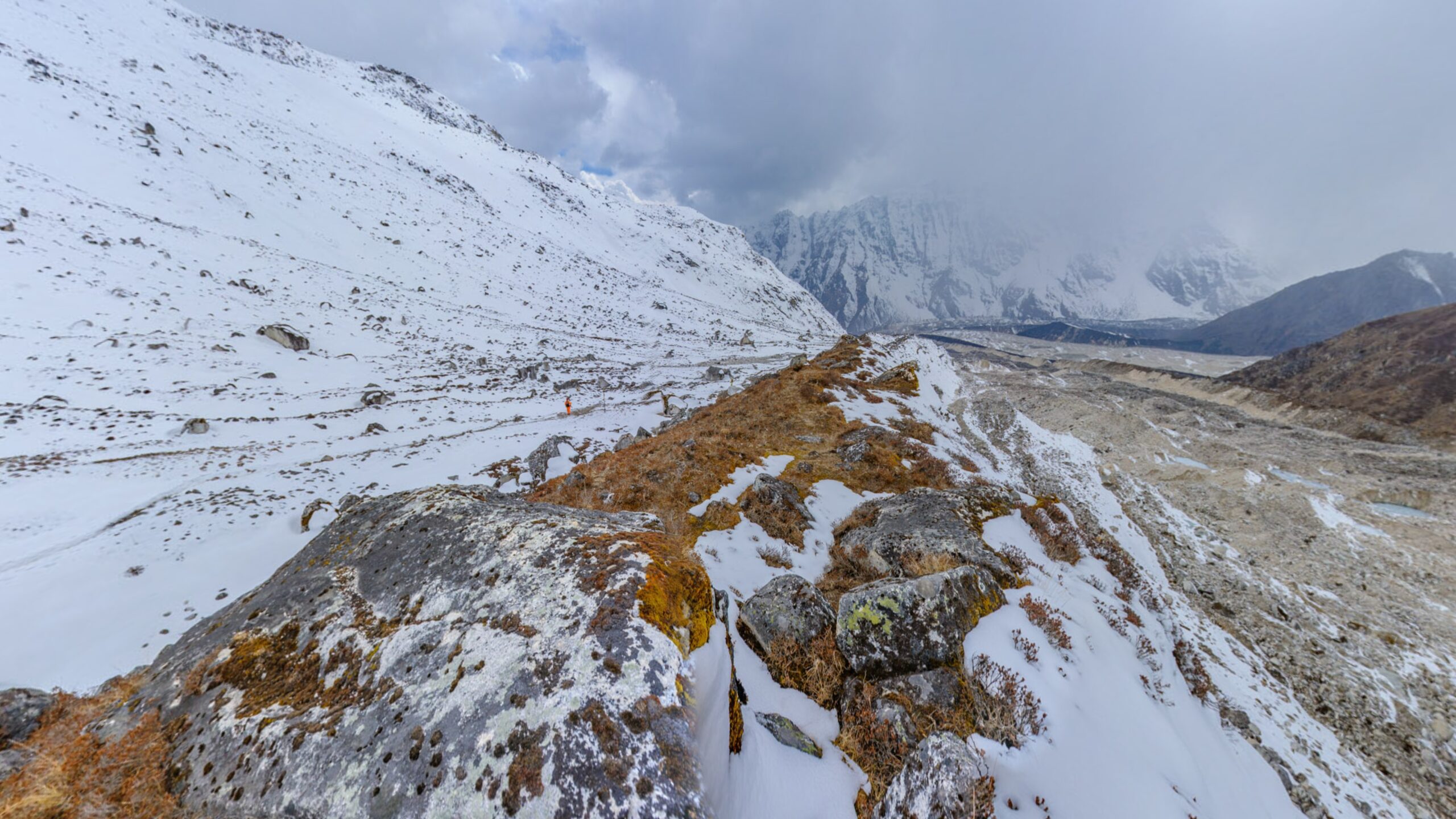
Annapurna Circuit and Annapurna Sanctuary Combined Trek is located in the Annapurna region. Annapurna Circuit Trek is recognized as one of the world's best trekking routes where the trekkers will have a great opportunity to explore the beautiful views of hills and Himalayas. This trekking provides the visitors with an opportunity to explore many different ethnic groups, their culture and traditions.
Included
- To ensure your safety and provide a smooth arrival experience, Asian Adventures offers complimentary airport pick-up and drop-off services for both international and domestic arrivals and departures.
- Representatives of Asian Adventures will be waiting for you at the airport with an Asian Adventures banner and your name placard for easy identification. The representative will also carry an official company ID card for verification.
- According to the trekking package itinerary, Asian Adventures arranges three nights of accommodation in Kathmandu in your selected hotel category, ranging from tourist-standard to five-star hotels.
- Asian Adventures provides experienced, government-authorized (licensed) high-altitude trekking guides throughout the trekking period.
- Surface transportation required during the trek and in major cities, as specified in the itinerary, is included.
- As per the itinerary, Asian Adventures arranges regular domestic flight tickets from Kathmandu to Lukla and Lukla to Kathmandu for trekking members and guides.
- During the trek, Asian Adventures provides comfortable accommodation in carefully selected tea houses (excluding chain hotels).
- Most lunches are taken along the trekking route, while breakfast and dinner are served at the tea house where you stay overnight. Asian Adventures provides clean and freshly prepared breakfast, lunch, and dinner, along with tea or coffee, from the tea house menu throughout the trek.
- To ensure your comfort and protection from cold weather, we provide clean and warm down jackets and sleeping bags during the trek.
- Asian Adventures allows up to 15 kg of personal trekking equipment per person, carried by porters, yaks, or mules during the trekking period.
- Since Everest Base Camp lies within the Sagarmatha National Park area, Asian Adventures provides all required national park permits.
- The Trekkers' Information Management System (TIMS) permit is mandatory for trekking in the Everest region. Asian Adventures arranges this permit for all trekkers.
- First-aid medical kits are provided for both trekkers and staff to ensure health and safety during the journey.
- Communication is an important safety factor in remote Himalayan regions. Therefore, Asian Adventures equips trekking guides with satellite phones for emergency situations.
- During your trek, Asian Adventures ensures clean, nutritious, and freshly prepared meals at tea houses.
- The quoted package price includes all official service charges, government fees, taxes, and VAT. There are no hidden costs beyond the stated price.
- Before departing Kathmandu, we invite you to join us for a farewell dinner at a traditional Nepali restaurant with a cultural performance. This provides a wonderful opportunity to experience Nepali culture and traditions.
- As a souvenir of your Himalayan adventure, Asian Adventures will present you with an Asian Adventures T-shirt, Pashmina, and company brochure before your departure.
Excluded
- Kathmandu offers a wide variety of high-quality restaurants serving Nepali and international cuisine. Therefore, lunch and dinner in Kathmandu (except the farewell dinner provided by Asian Adventures) are not included in the package cost and must be arranged by the client.
- Personal expenses such as snacks, packed foods, chocolates, energy bars, mineral water, soft drinks, energy drinks, alcoholic beverages, and cigarettes during the trek are not included. These items can be purchased individually according to personal preference.
- Expenses related to personal trekking equipment, laundry services, gratuities (tips), telephone calls, mobile services, internet usage, walkie-talkies, satellite phone usage, and other personal communication services are not included in the package.
- Trekking in the Himalayas is an adventurous activity conducted in remote mountain regions. For your safety, all participants must obtain comprehensive travel insurance before arriving in Nepal. The insurance policy should cover emergency helicopter evacuation, medical treatment, hospitalization, and other related expenses.
- International airfare to and from Nepal and the Nepal tourist visa fee are not included in the package cost and must be arranged by the traveler.
- Any additional expenses arising from unforeseen circumstances beyond our control, including natural disasters, adverse weather conditions, landslides, political disturbances, strikes, flight delays or cancellations, and changes in government regulations, are not included in the package cost.
- Costs associated with additional staff or services requested beyond those specified in the package are not included and will be charged separately.
- Any services not specifically listed under the "Package Includes" section will be considered additional services and will incur extra charges.
- Tipping is not included in the package price. Tipping guides, porters, and support staff is a customary practice in Nepal's trekking industry and is greatly appreciated as recognition of their hard work and service. The amount is entirely at the discretion of the client.
Travel Itinerary
Day 1 - Arrival in Kathmandu
On your arrival day, we'll greet you at Tribhuvan International Airport and drop you off at the hotel. We advise resting and preparing for your journey for a half-day. We will meet at our office in Thamel and help you with the final preparations for the trek.
Day 2 - Regular Bus Drive from Kathmandu to Besisahar and Sharing jeep from Besisahar to Dharapani (1860m.|6200ft.)
We will start our adventure by driving from Kathmandu to Besisahar in the morning with the regular bus departing from Kathmandu Buspark at Machhapokhari. The route usually takes around 6 to 8 hours, depending on the road conditions and traffic. Upon reaching Besisahar, we will switch the transport and take the shared jeeps heading toward Dharapani. From Besisahar to Dharapani, the roadway is off-road and bumpy, which might take another 3 to 4 hours. We will spend the night at Dharapani.
Day 3 - Trek from Dharapani (1860m.|6200ft.) to Chame (2610m.|8890ft.)
Today, we will begin our trek with an early breakfast in Dharapani. We will commence our hike with a walk through the lush forest of pines, oak, and maple trees, passing by several villages. If the weather is clear we can relish the mountain views of Lamjung Himal, Annapurna IV, and Annapurna II. After approximately 6 hours of trekking, we will reach Chame, where will stay overnight.
Day 4 - Trek from Chame (2610m.|8890ft.) to Pisang (3300m.|10824ft.)
After breakfast, we will collect our belongings and begin our journey to Upper Pisang. The scenery is stunning as we are in the mountains. The trail passes via forests, bridges, and rivers. The path is shared by mule trains that have jingling bells. The Upper Pisang village is dotted with traditional homes and prayer flags. The inhabitants are Buddhists, and it is common to see elderly people wearing meditation beads or little prayer wheels on their wrists. The Himalayan Mountains appear to be within reach. When we get to Upper Pisang, we go to a nearby teahouse to relax and enjoy a well-earned break.
Day 5 - Trek to Manang (3540m.|11612ft.) via Ngawal
As we go to Manang, we get amazing views of Annapurna III and II. As we climb higher, the air becomes drier and colder. The path passes through mountains covered with snow, ice rivers, and conifer-covered hillsides. Before proceeding to Manang, we make a quick stop at the charming village of Ngawal. The route is littered with chortens, Buddhist temples, and prayer flags. We reach Manang, our overnight stop, after hours of walking.
Day 6 - Manang Rest Acclimatization
We will stay an additional day in Manang to explore the community and acclimate to the high elevation. There are several side hikes we may start on. We must travel high and sleep lower to acclimatize. We may make the ascent to Gangapurna Lake and enjoy the day appreciating Tilicho, Pisang, Annapurna III, and Chulu Peaks' breathtaking magnificence. Additionally, we may climb up to the surrounding famous Ice Lake. We will have acclimated to the elevation and be ready for the next day after spending the day in the mysterious Manang village relaxing.
Day 7 - Trek to Yak Kharka (4050m.|13284ft.)
On the way to Yak Kharka, we'll see more breathtaking views of the mountains Gangapurna and Annapurna. Blue sheep, yak, and Himalayan tahr herds graze on the bushes and alpine grass. In some places, horses are still often used for transportation. We can see a few teahouses at Yak Kharka, a former yak herder camp. We travel to one of them, where accommodations have been reserved for us and check-in.
Day 8 - Trek to Phedi (4525m.|14842ft.)
The pass we have been hoping to cross since beginning our journey, Thorong La, is growing closer to you. One of the riskiest parts of the trail is the one that leads to Thorong Phedi. The gravel route, which is prone to landslides, is constrained and follows the edge of a desolate hill. Up here, well above the tree line, it's windy and dusty. Our overnight stop, Thorong Phedi, is encircled by sheer cliffs. As the highest overnight stop, this is at 4525 meters.
Day 9 - Trek to Muktinath (3710m.|12172ft.) via Thorong La Pass (5416m.|17769ft.)
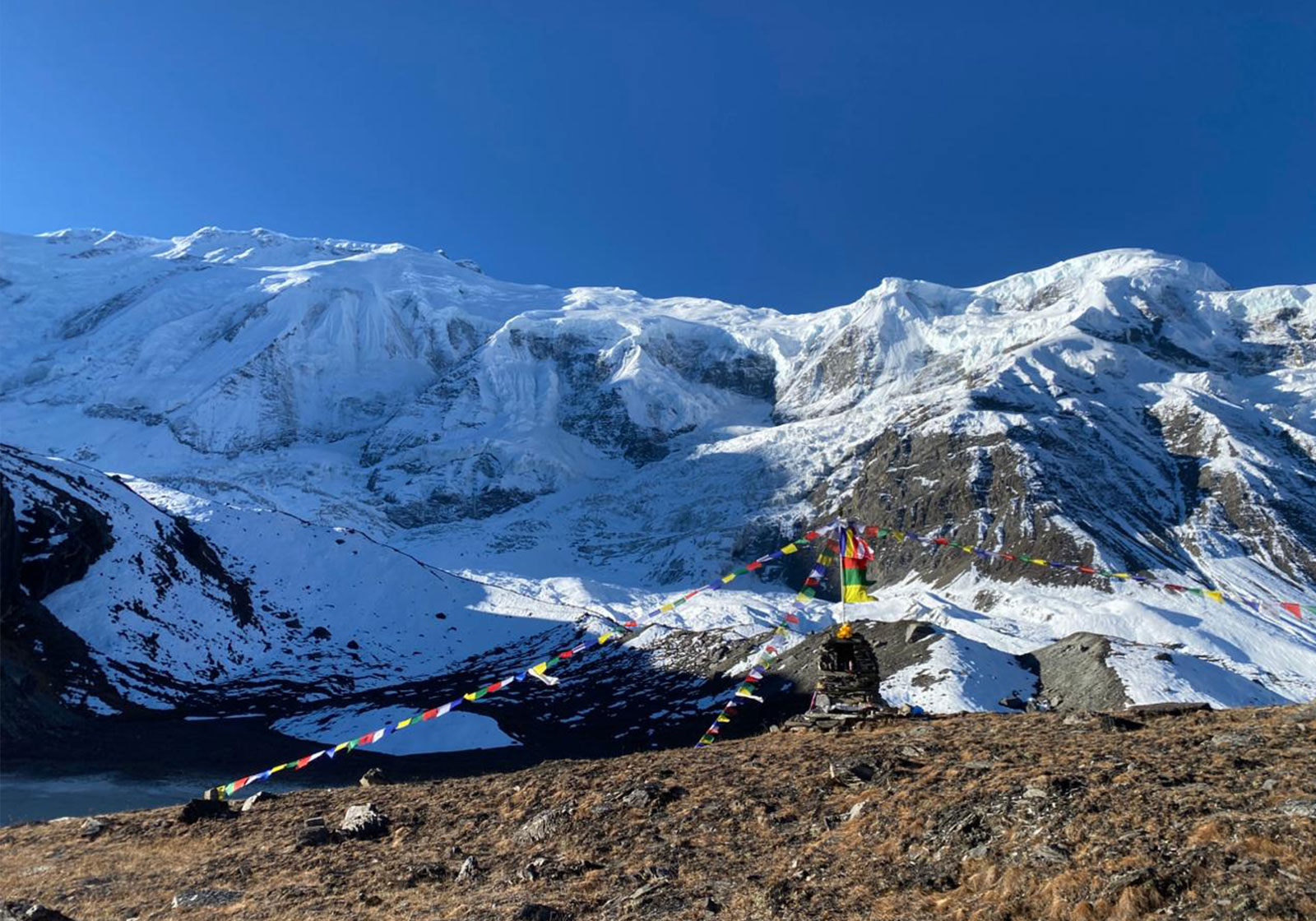
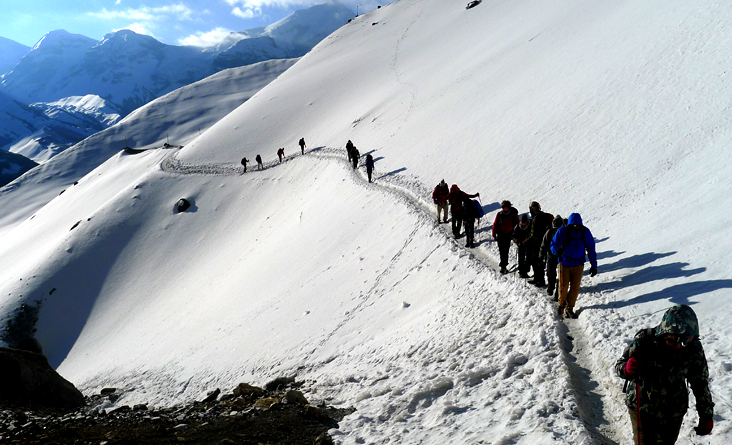
We get up early and hike up to High Camp. As the day goes on, the weather can be worse, so we need to get going early. Thorong La Pass must be traversed before it becomes too windy and cloudy. We start our ascend in the dark by using a headlamp. We rest and warm up in High Camp before continuing our walk. As a result of the thin air, breathing is challenging during the climb. Once we get to the pass, snap selfies and photos of the breathtaking mountain views. The Tibetan peaks are rising on the horizon in the distance. We spend a good amount of time admiring the colorful prayer flags adorning the snow-covered pass before continuing to Muktinath.
Day 10 - Drive Muktinath to Tatopani (1190m.|3904ft.)
After breakfast, there is a beautiful drive to Tatopani. The path travels through lush tropical rainforests and grassy pastures. Compared to the desert-like scenery of the previous several days, we will have a wonderful change. The humidity and temperature difference are there as we go lower in the air. Before reaching Tatopani, our destination for the night, we will pass through the checkpoint through Ghasa. Tatopani, which in Nepali means "hot water," is well for the hot springs. We can see travelers coming from around the world to take a dip in the hot springs' healing water.
Day 11 - Trek from Tatopani to Ghorepani (2874m.|9429ft.)
The route to Ghorepani is marked and stone-paved. We can see the signs pointing towards the direction of Ghorepani. It is a difficult hike through rhododendrons and oak trees till you reach Ghorepani taking the uphill and downhill paths. The town was known as Ghorepani since it was a well-liked resting place for traders riding horses to Tibet.
Day 12 - Explore Poonhill and Trek to Tadapani (2600m.|8530ft.)
We will hike to Poon Hill's hilltop observation point before sunrise. Poon Hill, which gives a breathtaking panoramic view of the Annapurna Massif, Gangapurna, Dhaulagiri, and Hiunchuli, is the most well-known Himalayan sunrise viewpoint inside the Annapurna Region. A sight to recall is the beautiful sunrise over the snow-capped mountains. After admiring the scenery and snapping photos, we will trek down to Ghorepani to gather our belongings before continuing to Tadapani. Through a dense rhododendron forest, taking a track that goes up and down, we can find one of the largest rhododendron woods in the world along this path. The trail is lined with blooming trees in the spring. After passing through Deurali and Birethanti, we will eventually reach Tadapani.
Day 13 - Trek to Chhomrong (2170m.|7119ft.)
Tadapani is where we start our journey to Chomrong. We can see Mt. Macchapucchre and the magnificent Annapurna South from the route. Chomrong is a little town surrounded by green hills, yet it is stunningly beautiful. It is the starting place and a well-liked rest break for the hikes to Annapurna Base Camp. Chomrong is bustling with stores, inns, and eateries.
Day 14 - Trek to Himalaya Hotel(2310m.|7579ft.)
This morning, we set out early to complete a lengthy walk distance. As we hike, we will take in the vistas of Chomrong Khola. We will soon arrive at Sinuwa, a little settlement standing on a hill. As we ascend higher to Bamboo village, the scenarios enhance even more. We will hike to Dovan from Bamboo. Oak, bamboo, and rhododendron woods are everywhere along the trail. To get to Dovan, we need to traverse several wooden bridges. From Dovan, we will climb for a few more hours until we get to the Himalaya Hotel.
Day 15 - Trek to Annapurna Base Camp (4130m.|13550ft.) via Machhapuchhre Base Camp
We will leave early in the morning for our major trekking destination, Annapurna Base Camp. We pass via the Machhapuchhre Base Camp. We will not experience the pain associated with hiking at such a higher elevation since our body is acclimated to the high altitude. From the Annapurna Base Camp, we will take in close-up perspectives of the Annapurna Massif.
Day 16 - Trek to Bamboo (2310m.|7579ft.)
We will get up early and head out to continue our trek. The trek is in a glacier basin surrounded by the peaks of Gangapurna, Hiunchuli, Annapurna South, and Annapurna I, the tenth-highest mountain in the world. We will take in the view of 8000 and 7000 meters high peaks. After taking photographs, descend to your teahouse.
Day 17 - Trek from Bamboo to Samrung and Drive to Pokhara (800m.|2625ft.)
To get to Matque, we will descend to Bamboo. Along the way, you'll pass through the villages of Chhomrong, Sinuwa, and Jhinu Danda. Your last hike route passes through typical Nepalese scenery, with farms and terraced fields. When we get to Samrung, crossing the long bridge after Jhinu Danda, we will take a vehicle headed for Pokhara.
Day 18 - Drive or flight from Pokhara to Kathmandu
Drive or flight from Pokhara to Kathmandu takes about seven hours by tourist bus and; 25 minutes by flight, overnight at Hotel accommodation, farewell dinner with culture program In the Evening.
Day 19 - Final Departure
Drop at the airport for final departure. (service: Airport drop service )
Maps
Frequently Asked Questions
Mount Annapurna is the 10th highest mountain peak in the world at 8,091 meters (26,545 ft) and the first 8,000m peak ever summited in 1950 by the French team led by Maurice Herzog. That summit and success brought new inspiration and created a milestone in mountaineering. Nepal was then introduced to the global arena. Adventure tourism in Nepal began after the climb. The Annapurna Circuit trek lies on the same route used by the French expedition team in 1950 to explore and climb Annapurna I. The expedition team first tried to climb Annapurna from the Manang Valley, and when they were unable to do so, they turned to the Mustang Valley and finally climbed.
Regular cardio exercises such as hiking with a backpack on uphill and downhill terrain, stair climbing (if outdoor hiking is not possible), running, or cycling are highly effective. Additionally, focusing on endurance, strength, and breathing exercises will help you handle the physical demands and high-altitude conditions of the trek more effectively.
As you are in a new country and exposing to unfamiliar bacteria and viruses, caution is required. Tap water in villages and teahouses used by locals is not safe to drink directly. Drinking untreated water can lead to stomach upsets, diarrhea, or other illnesses, which can spoil your travel experience. You can buy bottled water at most teahouses along the trek, which is a safe option. However, for environmental reasons and because it becomes expensive at higher altitudes, it is better to limit bottled water use.
From $888.00
Book This Tour

From $888.00
Book This Tour
You might also like